Wednesday, June 4, 2008

Waste 2

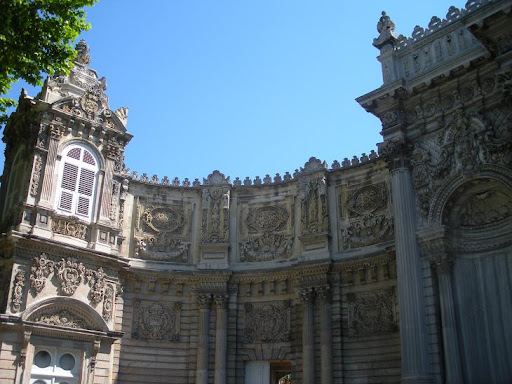
We spent the morning at Dolmabahçe Palace, the new imperial seat built by the sultans in the mid-1800s. It was intended to replace Topkapı with something more European.

Shoop de woop.

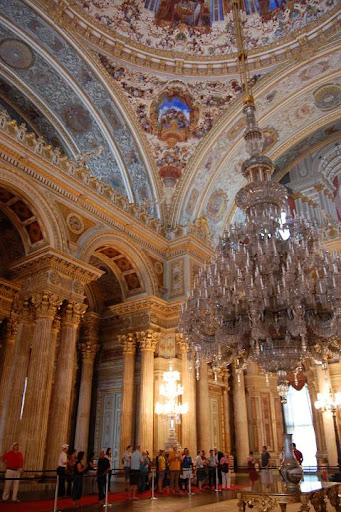
They clearly succeeded. It's very French. Veeeeery French. Also kind of gaudy. The whole thing cost 35 tons of gold. 14 tons of that went into gold leaf on the ceilings. The rest went into a whole bunch of clocks and unnecessary marble scrollwork.

Shoop de woop.

Walking through the palace I couldn't help but think of all the better uses to which the Ottomans could have put that money. The Janissary corps had just been disbanded about 20 years before the palace was built, and the military was still in shambles and in no way capable of competing with the Europeans. With the benefit of hindsight, we can say that the sultans should have spent their money preparing for WWI. Yet even without hindsight, it shouldn't have been hard to realize that there was going to be a major military shakeup in Europe. There were all kinds of ways the Ottoman Empire could have gotten itself ready to take advantage of that - industrialization, military modernization, encouraging the growth of a populace above the level of peasant, whatever. All of these are legitimate ways the Ottomans could have imitated European grandeur in a constructive manner. Just about the only investment that wouldn't help was building a giant palace. In the history of the world no one has ever won a war by outpalacing their opponent.

This frustrating train of thought brought to mind the stupid Byzantine wall renovation that's going on right now. They're still doing it! Forget the cool-looking but useless gestures and build yourself some bloody infrastructure, Turkey!

Of course, Dr. Shields pointed out that the U.S. is doing pretty much the same thing right now, ignoring the extremely obvious looming crises of tomorrow - a mounting need for alternative energy, brain (and, well, everything else) drain to other countries, etc - and wasting its time and money on really badly-thought-out wars and whatnot. So enough about the Ottoman obsession with useless monuments.

Specks of sand and planks, you know.

Tuesday, June 3, 2008

I don't really get this whole secularism thing.

Like the title says: I really don't get Turkey's secularism policy. I understand the concept just fine. But I can't figure out where they're drawing the line on public religion. Maybe they can't either, though.

This evening I attended the most ludicrously overt covert prayer meeting in the history of mankind. They called it a cultural music performance, not a Sufi prayer meeting that's theoretically illegal, but it was pretty obvious what it was, particularly when they started praying loudly with the windows open and lots of random tourists sitting in.

We talked with a women's rights NGO earlier today (though actually they deal with a lot of stuff besides women... let's just call them a rights NGO) who said that while many people may be arrested for observing zikir they're always found innocent and immediately released.

When Ataturk was still Mustafa Kemal, a military officer trying to push the Allies out of the Anatolian core of the Ottoman Empire, he took the title Ghazi, or 'holy warrior'. He officially dropped the title when he started trying to secularize Turkey, but apparently no one's told the military that - they're still calling Ataturk Ghazi today.

It seems like Turkey's still kind of torn on the religion deal. They can't possibly make the country as secular as Ataturk wanted - the people wouldn't stand for it. So they make a series of secularizing laws but don't actually enforce any of them. No government has ever had particular success with creating laws on principle but not enforcing them - it makes the government look weak and fails to discourage whatever the law is supposed to forbid. So maybe Kemalism ought to think about making a realistic accord with Islam rather than a feel-good arrangement that means nothing.

Hey! Listen!

Clayton remarked earlier in the trip that the Turks tend to kind of glower at tourists (including us) until given a reason not to. But it doesn't take a whole lot for that to change. A single word of Turkish ('Merhaba' works well) and they immediately open up (unfortunately opening up typically entails a stream of completely incomprehensible Turkish).

He's quite right. Generations of rather boorish tourists (or imperialists) from Europe would seem to have soured the Turks towards visitors from the West. Unfortunately, we as a hemisphere don't appear to be doing much to improve our reputation amongst the locals. I spent a morning a few days ago painfully slogging through Lewis V. Thomas' Elementary Turkish (revised and edited by Norman Itzkowitz) at a teahouse up the street from our flat. A German gentleman a few tables away commented "Elementary Turkish... not the typical tourist, then," and he was right. From what I've seen very few of the foreigners coming to Turkey bother to learn any of the language. (Including the German, incidentally, who in fact was not a tourist. He's been a teacher at one of Istanbul's universities for a few years and has completely despaired of ever learning any of the language.)

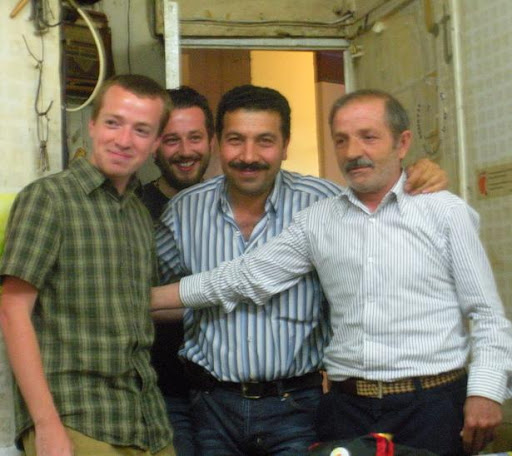
But the potential remains for rapid, if not immediate, reconciliation. The minute you say "Merhaba!" the Turks start to thaw. If you ask them how they're doing you might as well be family. Earlier today we were coming back from some exploration when we happened to glance in and toss a casual "Merhaba" at the old and rather enigmatic Turk who would appear to run some sort of shop on the ground floor of our building. With disorienting rapidity this developed into drinking tea with him and several other equally enigmatic Turks. We learned that he sells lapel pins, that he has a computer with the internet but hasn't been able to figure out e-mail just yet, and that he's been playing the saz for 40 years (he's quite good).

Beautiful places, smiling faces.

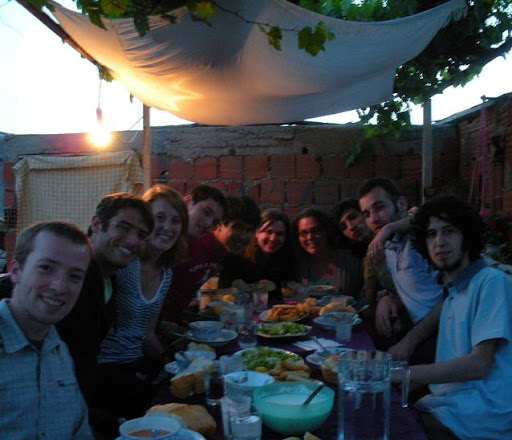
We've just returned from a Sufi music rehearsal we were invited to attend. Except the music rehearsal blended into a prayer meeting, and the prayer meeting blended into a dinner, and the dinner blended into a birthday dance party for one of the musicians, and we were invited and included in each phase of the evening.

Today may have impressed on me more than any other (well, maybe besides the Bursa experience) that the Turks aren't some unknowable Other that can never be at peace with the West, no matter what certain members of the EU may think. It takes a tiny gesture of goodwill - saying hello in the language of the country you're visiting - to get the Turks to open up and be unbelievably hospitable. Showing a modicum of respect at the political level could have similar results.

For my mother

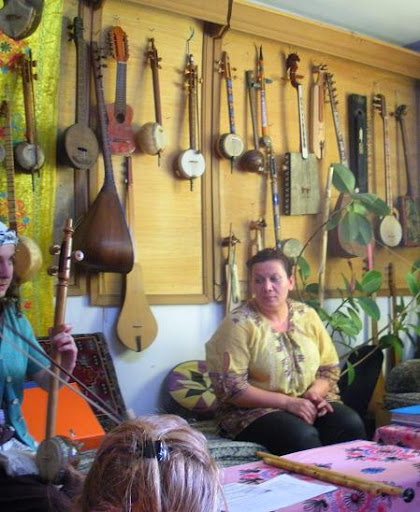
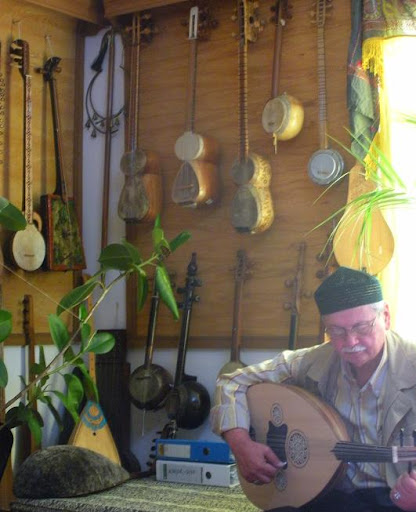
This evening we got a pretty heavy dose of traditional Turkish music (on stringed instruments, no less!) at a kind of covert Sufi prayer meeting that we attended (it's covert in that it's described as a music store/museum in which they play traditional cultural music. It's not in any way quiet or well-hidden, really... but another post on that later tonight). Knowing that one member of my family would have loved to have been there, I took lots of video and audio recordings of the music. Unfortunately uploading any of them would take forever, so for now we'll look at still images.

Musical stuff.

More musical stuff.

According to William a lot of the instruments you see on the walls here were effectively extinct. The owners of the museum did their best to build them anew based on drawings and descriptions from days of yore. Cool stuff.

Monday, June 2, 2008

Waste

We spent most of the day walking the remains of the Byzantine land wall around the old ‎city. This is, of course, the Wall to end all walls, the wall by which all other huge walls ‎are measured (well, except for the one in China), the wall that only got a hole knocked in ‎it when the Ottomans built some of the most ridiculously large cannons ever specifically ‎for the purpose. Needless to say I was pretty excited. ‎We began at Yedikule, a pretty classy-looking star fort at the eastern edge of the land walls, and walked the length of the wall to the Golden Horn.

Nothing clever comes to mind here.

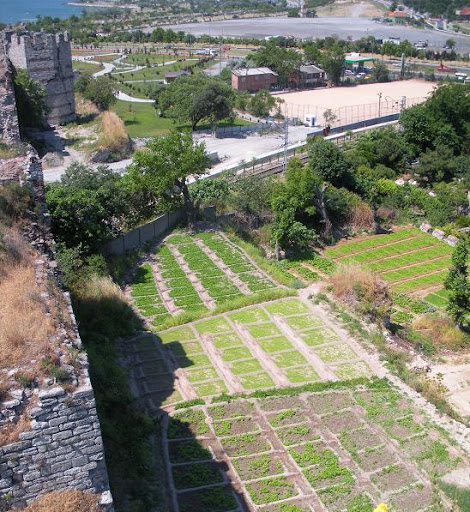
The space in between the walls is being used to grow crops! How hilarious! It's a ‎pacifist's dream come true. I'd assumed this was some post-siege warfare development, ‎and I already had some clever "the Turks have beaten their swords into plowshares" line ‎prepared for the blog, but Dr. Shields informed me that this space actually would have ‎been used for crops in olden times as well. Like, during sieges and all. So... huh. That's ‎weird. ‎

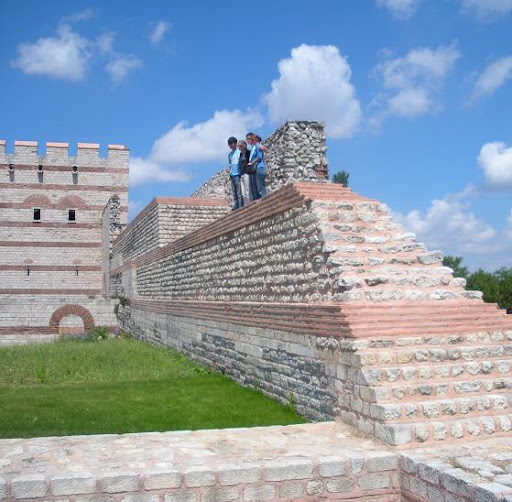
The Turkish government is working on a HUGE restoration project trying to rebuild the ‎walls to their original glory. ‎Since the walls run a good six kilometers along the landward side, and since they've been falling apart for a few hundred years, it's going to take some doing.

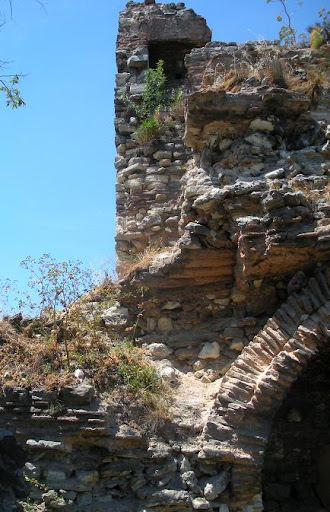
Here's what they look like now.

I am decrepit!

It's a work in progress.

I am somewhat less decrepit!

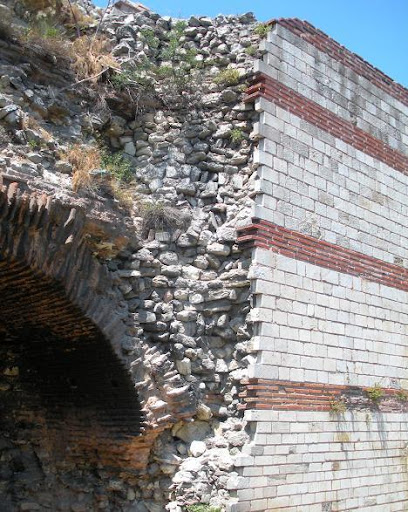
And here's what they're working towards.

Like a proper European exhibit, there. Bravo.

Periodically along the restored sections they'll have cut-away sections like the above, presumably to illustrate the thickness of the walls to the roving band of academic tourists (though how many of those are there, really? How many tourists make it off Divan Yolu?). All in all it's a hugely impressive undertaking.

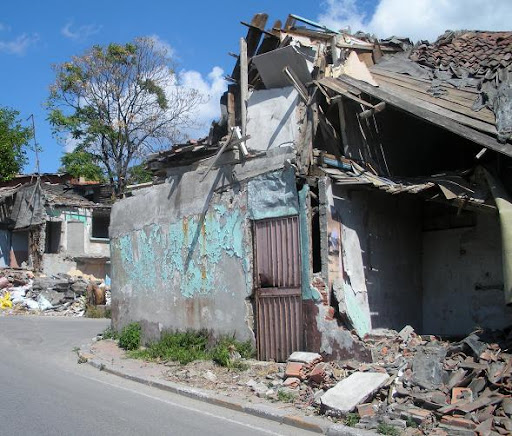
It's hard to imagine the amount of money being put into the project. It's even harder to imagine what material benefits Turkey's getting out of it. Dr. Shields explained that it's largely to build legitimacy with the West, which is big into archaeological preservation and such. Now obviously Turkey has to engage in the big projects that make it part of The Developed World. But walking the walls it was hard to accept that rebuilding them needs to be the biggest priority for Turkey. On one side of the street you have this ginourmous restoration project underway, while on the other side of the street you have

That's looking about as decrepit as the wall.

It seems to me like maybe dealing with neighborhoods that look like that, and the people who live in them, is more pressing than rebuilding the walls. How much money is being spent on the walls? How much could that money do for all of the extremely poor districts along those walls?

As much fun as strutting with the Europeans and reminding the world of your past glories is, I feel like it'd be a more impressive (and definitely more prudent) to move Istanbul forward rather than back. The walls look beautiful, but it's kind of hard to be truly impressed when they're sitting in a giant slum.

Sunday, June 1, 2008

Peace rally

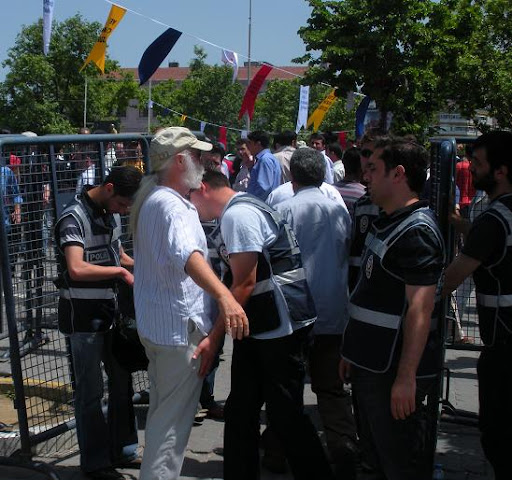
I spent a few hours this afternoon at a pretty large pro-Kurd peace protest in the Kadıköy district. It was surprisingly open - I mean, there was security

Easy on the goods, boys.

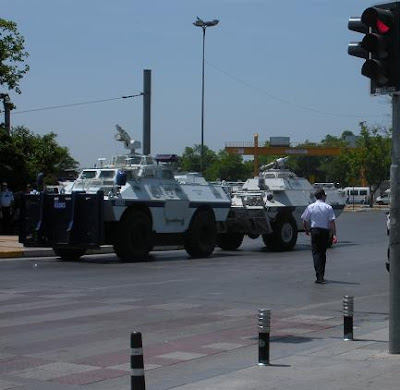
and there was backup security

How hilarious would it have been if this was a picture of a tank?

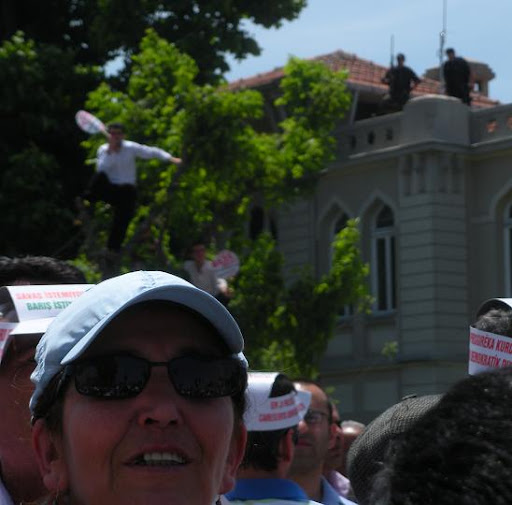
but for a protest openly criticizing the military and calling for a peaceful resolution to the Kurdish separatism problem, which the military has always been very sensitive about, it was very... peaceful. This isn't to say the military wasn't keeping an eye on things.

I'm talking about those two guys up in the top right corner.

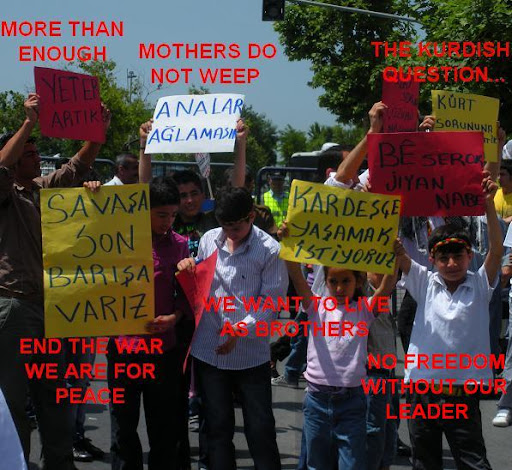
But it was still a far cry from every impression I've ever gotten of Turkey being essentially a police state that doesn't allow any public criticism of the government or the military. There was a lot of chanting, a lot of singing, a lot of generally pro-Kurd peacenikery, and the military just sat and watched. It was an exciting atmosphere, because you could see this general feeling of "Hey! Freedom of speech! This is fun!" (I've got a bunch of video of Turks leaping around wildly in support of peace. Unfortunately it would take me a year and a half to put it on the internet, but I'd love to show it to all of you in person at some point.) In the meantime, I went ahead and translated some of the signs people were waving around.

I believe the children are our future.

OK, so the one kid apparently calling for Abdullah Öcalan to be freed is less heartwarming than the others, but still. Things are clearly changing in Turkish public discourse. I'm sure the world will be happy.

----
EDIT 8 June 2008

Ok, I guess the world won't be happy, because the world doesn't know anything about it. The Turkish press is calling this the biggest pro-Kurd peace rally ever held in western Turkey. The international press isn't calling it anything, because in the last week no one in the West has reported on it (that I've found, anyway - I'd love to be proved wrong). The only press it's gotten from the international community is the Al-Ahram Weekly out of Cairo, which isn't exactly the source every Westerner goes to for breaking news.

I understand the whole principle of "if it bleeds it leads" but this is still important news even if no one is bleeding. Actually it's important news particularly because no one is bleeding. Turkey's getting better, just like we wanted! But what's their incentive to improve if we only pay attention when they do something wrong?

Completely overwhelming hospitality

I've returned from an exhilarating weekend in Bursa. The weekend was rather short on politically relevant realizations but long on Turkish cultural immersion, which I guess is probably worth something. I have a newfound appreciation for Turkish hospitality, which is truly incredible. The following is a chronicle of Turks being hospitable for absolutely no reason.

When we decided we wanted to go to Bursa for the weekend, we talked to a guy living in our building who's from there, hoping to get some recommendations about what to see. He told us that he was actually going home for the weekend and he'd love to help us get there, find us someplace to stay, and show us around the town. He then started calling friends in Bursa to get various family members shuffled around so that we could stay at someone's house instead of paying for a hostel. We've known this guy for maybe a week.

We elected to take a bus the entire way, which was by far the cheapest option. Murat ended up having to stay in Istanbul for a few hours later than our bus, so we went alone. Various Turks befriended us and chatted with us along the way. The most notable was one man who, discovering that my interests were primarily in the Arab Middle East, told me that Turkey was better, because Arabia had been occupied by the West for so long that the Arabs think English, while the Turks still think Turkish. My mental response to this was "Oh, you wacky nationalist Turks." We'll return to this later.

We arrived in Bursa without Murat (he'd been held up in Istanbul and wouldn't be able to join us until the next morning) and without any idea what we were doing. Immediately after stepping off the bus, however, we were greeted by three very enthusiastic Turks named Selman, Taner, and Eyup who said "Americans? OK!" and took us into town. We entered Eyup's house like the Janissaries taking Constantinople, where we were welcomed with a smörgåsbord of alcohols (by which I mean Efes, apparently the only beer available in the entire country, and wine) bought by Taner's cousin Orhan (to review, he's the cousin of a friend of a friend of our acquaintance).

After talking late into the night the topic of sleeping arrangements arose. The Turks were intending to have all of us sleep in Eyup's room while they slept elsewhere in the house. We expressed some concern about their comfort, but Selman assured us they would be fine and that there were plenty of couches and chairs and whatnot for them. The situation became somewhat murkier, however:

Us: So you guys are sleeping upstairs?
Selman: Yes. Upstairs.
Us: You've got someplace to sleep?
Selman: Yes.
Us: Beds?
Selman: No, there are no beds.
Us: Couches? Chairs?
Selman: Well, no, there are no couches. I will sleep in a chair... Actually, there are no chairs, but the floor is very comfortable.

As we'd met these gentlemen only hours before, the prospect of them sleeping on the floor while marauding Americans slept on beds and futons horrified us, and we protested. There was a terrific culture clash wherein American notions of privacy and unobtrusiveness manifested as our insistence that we'd sleep on the floor, in the hallway, or whatever, and clashed against the Turkish compulsion to honor guests, which likewise manifested as the Turks' insistence that they'd sleep on the floor, in the hallway, or whatever. In the end we split the bed and futons in the room between nationalities and crammed all 10 of us in. It was rather crowded but there was a strong sense of having come to a successful cultural compromise.

We awoke in the morning rather cramped and uncomfortable (the inevitable result of any cultural compromise). Selman informed us that Murat wouldn't be coming to Bursa at all due to some financial situation (a satisfactory explanation of this required more English than Selman possessed - all we know is that it involved Murat overseeing or regulating something and a loud sucking noise, which Selman made repeatedly in the apparent expectation that we would know exactly what he was talking about). To review again, we would be hosted for the remainder of the weekend by the friends of a very new (and very absent) acquaintance. Having settled this we took to the streets of Bursa.
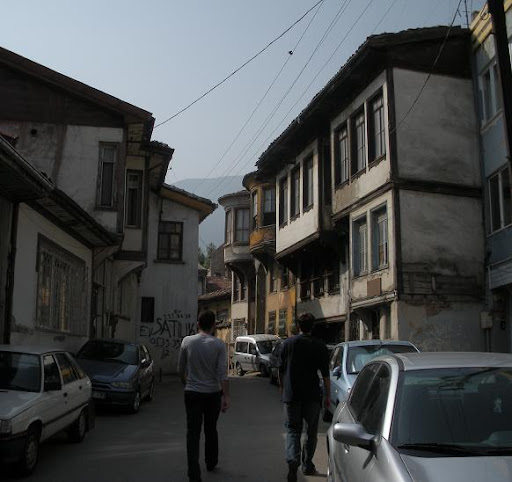
How picturesque.

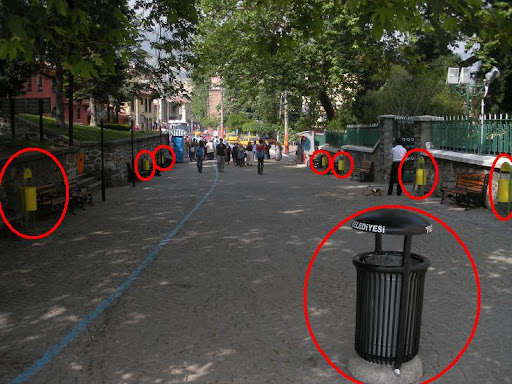
Incidentally, I figured out why there are no trash cans in Istanbul.

Overboard much?

They're all in Bursa.

Our Turkish compatriots took us to see all the major historical sights of the city, including the tombs of Osman and Orhan, and finishing with a trip to one of the local hamams.

How picturesque.

I have no idea what's going on with my mouth there. Whatever. Good times were had by all.

As we left the hamam the Turks informed us they had a surprise for us - dinner with Taner's family. We figured, hey, why buy a döner on the street when you can get a free döner at someone's house? Man, we had no idea.

We arrived at Taner's house and ascended through five floors of his extended family to the rooftop. We then got stuffed fuller than at any previous point in our lives. There were maybe seven courses of food, each of which could have been considered a full meal by itself.

And that's just the appetizers.

It was pretty overwhelming.

The others were staying for another night, but I wanted to return for a peace rally being held in Istanbul on Sunday. Selman, Eyup, and Taner all walked with me to the bus stop and waved me off. As I was riding back I found myself thinking about the guy on the ferry who told me that the Arabs think English and the Turks think Turkish. I now feel like I have a pretty good idea of what 'thinking Turkish' entails - making any guest feel like a member of the family (if not visiting royalty).

But what is thinking English? In Cairo I was often offered tea by a merchant, which was pleasant, but the cost of the tea was usually added to my purchase, or if I decided to buy nothing, the merchant would exclaim, outraged, "But I offered you teaaaaaaa!" Now, granted, this capitalized concept of hospitality may be unique to tourist-ridden Egypt - my few days in Jordan were an absolute delight and I got free tea in a variety of hilarious circumstances. But then, Jordan wasn't ruled by Britain nearly as directly as Egypt. In Egypt, where Western imperialism was perhaps the most long-lasting and deep, hospitality is not an end in itself but a means to achieve greater profit.

Is this 'thinking English'? If so, why on Earth do the Turks want to become more Western?